For Residential Hardscape & Outdoor Living Contractors
How to Add 2-3 More High-Value Hardscape Projects Each Month
Too many marketing metrics answer the wrong questions.
The ones that matter tell you whether or not you will be able to keep your crews busy doing profitable work.
We start with a few simple numbers (see calculator below):
- What is an average project worth?
- How much gross profit is in it?
- How many more projects do you want?
- How many serious prospects does it normally take you to close one?
Then we work backward to determine what it may take to bring in those additional jobs.

Completed Project
Outdoor living - Fire feature - Paver patio
The Real Problem
Great Work Doesn't Guarantee a Full Schedule
You can have good crews, great-looking projects, strong reviews and years of experience - and still hit stretches when there isn't enough good work coming in.
Referrals help, but they're hard to predict.
Some leads never get answered quickly enough.
Some homeowners find competitors before they find you.
And sometimes you're spending money on marketing without knowing whether it's actually helping you land profitable jobs.
Before deciding where to spend money, there's a more important question:
What is one additional job actually worth to your business?
Run Your Numbers
What Can You Afford to Spend to Win One More Job?
Put in your own numbers. We'll show you roughly what one additional project is worth, how many serious prospects you may need, and what different costs to win the job could mean for your bottom line.
If you're unsure, use your best estimate.
Includes advertising and marketing costs. Your actual plan will use your market and service mix.
One Average Project
$15,000
Approx. Gross Profit on One Project
$6,750
Additional Monthly Sales
$45,000
3 more projects per month
Serious Prospects Needed
About 10
per month
Monthly Cost to Win 3 Jobs
$5,250
Gross Profit Remaining After That Cost
About $15,000
These are planning estimates, not guarantees. Actual results depend on your market, pricing, sales process, competition, service area, lead quality and other factors.
What happens at different costs to win the job?
| Cost to win each job | Monthly cost for 3 jobs | Gross profit remaining |
|---|---|---|
| $750 | $2,250 | $18,000 |
| $1,500 | $4,500 | $15,750 |
| $2,250 | $6,750 | $13,500 |
| $3,750 | $11,250 | $9,000 |
Now Let's See What It Would Take to Land Those Jobs
The Better Question
Stop Judging Marketing by the Cost of a Lead
A $100 lead can be expensive if it goes nowhere.
A $1,000 lead can be cheap if it turns into a $15,000 project.
What matters isn't simply what a lead costs.
What matters is what it costs you to land a profitable job.
That's why we start with the value of the job - not with a marketing package.
How We Help
Once We Know the Number, We Work on Getting the Jobs
Get Found
Put your company in front of homeowners who are actively looking for the kind of work you do.
Possible services may include
- Google Search
- Google Maps
- Local SEO
- Paid search
- Project / service pages
- Local visibility
Turn More Inquiries Into Real Opportunities
Make it easier for homeowners to trust you, see your work and take the next step.
Possible services may include
- Website improvements
- Strong project galleries
- Reviews
- Clear calls to action
- Call and form tracking
- Chat
Stop Letting Good Leads Slip Away
Make sure calls and inquiries are answered, followed up with and tracked.
Possible services may include
- Missed-call response
- Text and email follow-up
- CRM
- Lead tracking
- Automated reminders
- AI answering where appropriate
Free Growth Analysis
What Happens During the Free Growth Analysis
Step 1
We Look at Your Numbers
- Average project size
- Gross margin
- Current sales volume
- How many more jobs you want
- Close rate
- Current capacity
Step 2
We Look at What's Happening Now
- Where your leads come from
- How easy you are to find
- What homeowners see when they find you
- How quickly inquiries are handled
- How leads are followed up with
- Where prospects may be getting lost
Step 3
We Show You What We'd Fix
You'll see what we believe needs attention, what it may cost, and whether the numbers make sense.
Then you decide.
You'll see the full picture, but you won't be expected to do everything at once.
We'll help you separate:
- What should be fixed first
- What can wait
- What is worth testing
- What may not be worth spending money on at all
You decide what - if anything - you want to do next.
No obligation. No requirement to buy anything.
Sample 12-Month Plan
You Leave With a Plan Built Around Your Business
A contractor trying to land three $15,000 projects needs something very different from one trying to land one additional $100,000 backyard project.
That's why we don't start by choosing Google Ads, SEO or some other service.
We figure out the job target first.
Then we determine what needs to happen to pursue it.
The sample below models a contractor pursuing higher-value projects - the same arithmetic the calculator above runs, with the project value moved up.
SAMPLE GROWTH PLAN - ILLUSTRATIVE PROJECTION
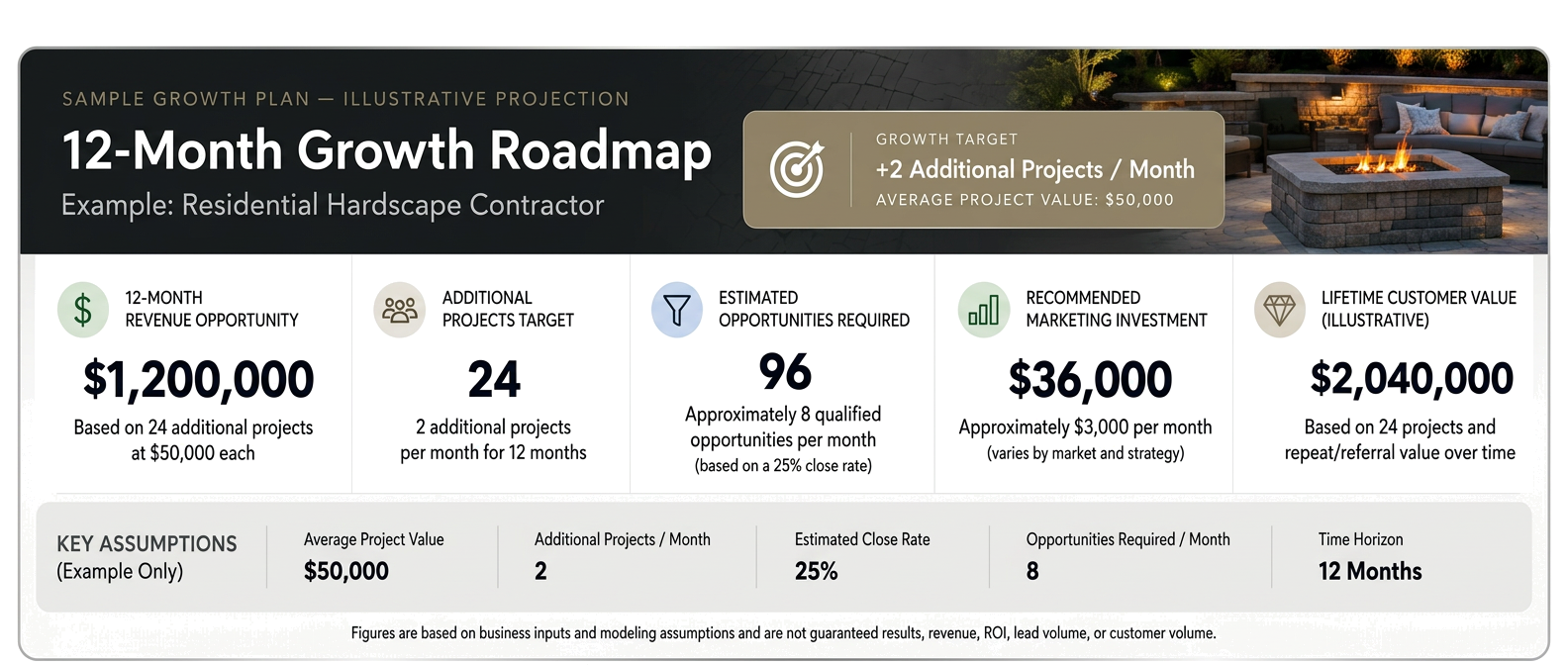
Growth Target
2 Additional Projects / Month
Average project value: $50,000
- 12-month revenue opportunity
- $1,200,000
- Additional projects target
- 24
- Estimated opportunities required
- 96
- Recommended marketing investment
- $36,000
- Illustrative lifetime customer value
- $2,040,000
Example only. Figures are based on business inputs and modeling assumptions, not guaranteed results.
Example growth-plan projection only. Figures shown are based on business inputs, assumptions, and modeled performance. They are not guaranteed results, revenue, ROI, lead volume, customer volume, or project volume.
Reporting
Know What You're Getting for the Money
You should be able to see:
- How many inquiries came in
- How many were worth pursuing
- How many estimates or sales appointments you had
- How many jobs you won
- What those jobs were worth
- Where those customers came from
Inquiries
18
Worth Pursuing
10
Estimates
6
Jobs Won
2
Value of Jobs Won
$30,000
Average Job Value
$15,000
From Inquiry to Job Won
- Inquiries18
- Worth pursuing10
- Estimates6
- Jobs won2
Where Customers Came From
- Google Search ads42%
- Google search results23%
- Google Maps18%
- Direct11%
- Referral6%
Example only. The numbers shown here are an illustration, not client results. What can be tracked depends on the work being done and the information available.
Who It's For
Built for High-Value Residential Outdoor Contractors
Timeline
What Happens After We Start?
First
Measure what's already happening and fix obvious leaks.
Next
Strengthen your visibility, follow-up and lead handling.
Then
Increase the flow of good prospects where the numbers justify it.
Over time
Track what is producing profitable jobs and put more effort behind what works.
Some things can improve quickly. Others, like search visibility, build over months. The pace depends on your market, your starting point and what the plan includes.
Why This Approach
Why Not Just Hire an SEO Company, Ad Agency or Lead Service?
Because no single tactic answers the most important question:
Will this help you land profitable jobs at a cost that makes sense?
SEO may be part of the answer.
Paid ads may be part of the answer.
Better follow-up may be part of the answer.
Often it's a combination.
We start with the job target and the numbers, then decide which pieces actually deserve attention.
Timing & Commitment
A Plan Doesn't Mean a Big Commitment
You don't have to wait until the schedule gets thin to figure out where the next jobs are coming from. And you don't have to commit to every recommendation at once.
Why Do This Now?
The jobs you should have won are business losses. The longer this continues, the more expensive it gets.
When contractors wait until the phone slows down, they're forced to react. And the things that create dependable work - stronger Google visibility, better reviews, better follow-up, stronger project pages - take time to gain traction.
It's much easier to fix gaps while your crews are busy than after the schedule starts thinning out.
The jobs filling your schedule today were sold weeks or months ago. What matters is what's entering the pipeline now.
Do I Have to Do the Whole Plan?
No.
The plan is comprehensive because you deserve to see the whole picture. That doesn't mean you do everything at once.
We'll model the expected results of doing only parts of the plan - one problem fixed, one new lead source tested, one follow-up improvement made - so you can decide what to tackle first.
Start where the numbers make sense. See what happens. Then decide what deserves the next dollar.
The plan can be comprehensive. The commitment doesn't have to be.
FAQ
Questions, Answered.
Start with the numbers. Everything else follows from there.
Marketing systems take time to build, and waiting until demand is soft or the busy season starts usually makes each qualified opportunity more expensive.
No. The analysis can show the full picture while still separating the work into practical pieces that can be started one at a time.
The analysis is free. Any paid work is scoped after the numbers and gaps are clear.
Follow-up and conversion improvements can show earlier signals, while search visibility and brand trust usually take longer to compound.
Not necessarily. If the current site can support tracking, conversion, and service positioning, we improve what is already there.
This offer is focused on hardscape, outdoor living, paver, pool, retaining wall, and outdoor kitchen contractors because the math depends on high-value project work.
Then the analysis reviews what those channels are producing now, what is not being tracked, and whether spend should be shifted, tightened, or supported by better conversion assets.
Use a reasonable estimate for the first pass. The purpose is to reveal the ranges that matter and identify which numbers should be tracked more accurately.
No. The work is planning and execution around your own demand system, not reselling shared leads.
No. The analysis is free, and you do not have to buy services or start a package afterward.

Final Step
How Many More Profitable Projects Would Make a Difference This Year?
Start with the numbers.
We'll look at what one additional job is worth, how many serious prospects you may need, what's already working, and what may need to change.
See the whole picture before you decide what to spend.
No obligation to implement everything.
No requirement to buy a big package.
Start with what makes sense for your business.
No obligation. No generic marketing package.